Tools and checklists
A baby-planning binder: what to put in and how to keep it alive
Build a paper binder for the baby plans you share: seven tabs, a one-page front sheet, a pocket for ideas and quotes, and a 15-minute weekly habit that keeps it used.
By the Bloom team12 min readUpdated November 6, 2026
Sources checked on November 5, 2026
In this article
- Why a binder, when you have a phone
- What you need, and nothing more
- The seven tabs
- The front sheet: one page that runs everything
- The weekly habit that keeps it alive
- The Pocket: a home for ideas and quotes
- One binder for two people
- Set it up in one evening
- When the binder goes stale
- Binder and screens: who does what
- Questions people ask about planning binders
You are planning for a baby, your plans live in a notes app, a few browser tabs, two screenshots and a conversation from last Tuesday, and you would like one object you can put on the table and point at. A paper binder can be that object. The hard part is not building it; most binders are assembled in one weekend and abandoned by the end of the month.
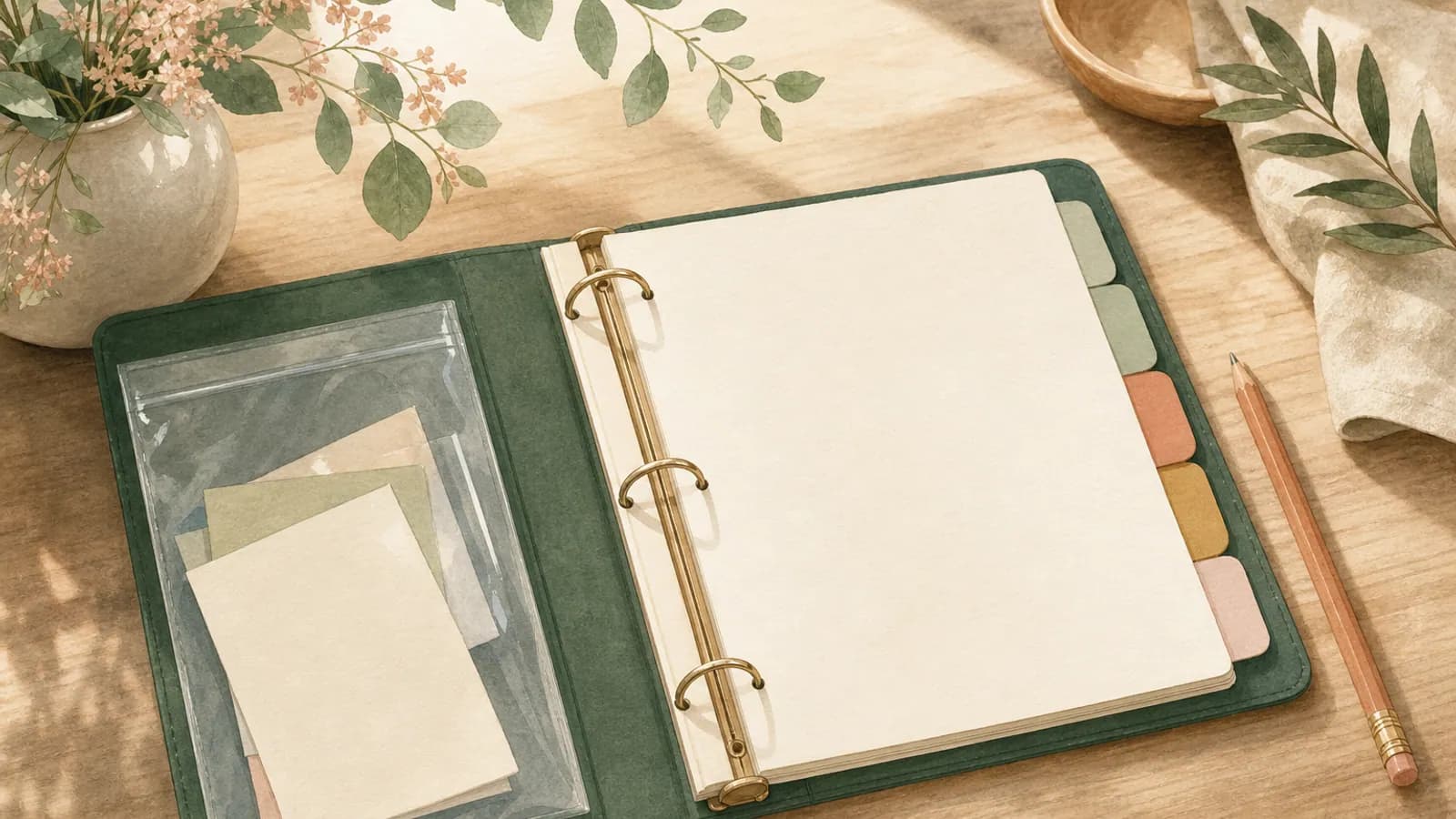
This article is about the physical binder as a ritual: which tabs to use, what goes behind each one, how a single front sheet keeps it honest, a pocket for the ideas and quotes that do not fit anywhere, and a weekly 15-minute habit that keeps the whole thing alive. If you want to decide what to keep in a folder and how to name files, see what to keep in a planning folder; for the single page of household facts, see the household information sheet.
Why a binder, when you have a phone
A phone stores things well and shows them poorly. When plans are spread over several apps, nobody sees the whole picture, and the person who knows where everything is quietly becomes the project manager. The Greater Good Science Center describes how, in many couples, one person ends up carrying the planning and the reminding. A shared object on the table is a small way to spread that responsibility out.
Paper has three advantages here. It is visible: a binder on a shelf says "we are working on this". It is finite: a tab holds only so many sheets, so you must decide what belongs. And it is shared by default: two people can turn the same pages and disagree with a pencil instead of a notification.
Paper cannot search itself or send a reminder, and it is easy to leave in the wrong room. That is why most of this article is about a habit rather than stationery. A binder with no routine is a decorative folder.
What you need, and nothing more
- A sturdy A4 or letter-size binder with two or three rings, about 5 cm (2 in) wide.
- Eight dividers: seven for the tabs below and one spare for the back.
- A hole punch that lives next to the binder, not in another room.
- A pencil, a pen and a highlighter, ideally clipped or tied to it. Pencil for anything that might change, pen for decisions.
- A clear pocket sleeve for the Pocket tab and some blank and lined paper.
Where the binder lives matters more than its colour. Put it where you both pass every day, such as a kitchen shelf, so that opening it takes less effort than not opening it.
The seven tabs
Seven is a deliberate limit: every extra tab is one more decision about where something goes. The table shows what belongs behind each divider and what does not.
| Tab | Name | Goes in | Stays out |
|---|---|---|---|
| 1 | This week | The front sheet, this week's three tasks, the next meeting | Anything older than a month |
| 2 | Decisions | One page per decision: question, options, choice, date | Open debates with no page yet |
| 3 | Money sheets | Blank budget and savings sheets you fill in by hand | Statements, account numbers |
| 4 | Home and things | Room-by-room lists, wish lists, measurements | Receipts from years ago |
| 5 | People | Who does what, names of helpers, a help list | Private notes about anyone |
| 6 | Dates | A 12-month overview and a list of deadlines | Every small reminder |
| 7 | Ideas, quotes, clippings, slips with no home yet | Anything that has a home |
Rename a tab if the words do not suit you. Keep the count at seven.
Two tabs worth explaining
This week: you open this tab every time. It holds the front sheet (next section), then a fresh page for the current week. When a week ends, that page goes to the back or into the bin.
Decisions: planning involves a stream of small choices, such as whether to borrow or buy. Give each one a page with four lines: the question, the options you considered, what you chose, and the date. The planning journal prompts pair well with this tab.
The front sheet: one page that runs everything
The front sheet is a single page, always the first thing you see, that answers three questions in under a minute: what are we doing this week, what are we waiting for, and when do we next sit down together? Copy the layout below and rewrite it by hand each week.
Front sheet layout (copy this onto one page)
Top of the page
- Week of: ____ (date of Monday)
- Next meeting: day ____, time ____, place ____
This week: three tasks, each with one owner
- 1. ______________ Owner: ____ Done by: ____
- 2. ______________ Owner: ____ Done by: ____
- 3. ______________ Owner: ____ Done by: ____
Waiting for
- ______________ (who or what, since when)
- ______________ (who or what, since when)
Bottom of the page
- One thing that went well this week: ______________
- One thing to drop or postpone: ______________
Three tasks is the point. If you are unsure what the three should be, sort first: a one-hour pass that places every idea as now, later or never leaves you with a short list. The "waiting for" box is the quiet hero of the page. It records the things that are stuck on someone else, so nobody carries the worry of remembering to chase them.
The weekly habit that keeps it alive
Binders die of neglect, not of bad design. The remedy is a short, fixed slot with the same three moves. Fifteen minutes is small enough to survive a busy week. Better Health Channel advises setting aside time to talk without interruption, with phones and screens put away, and this slot is a miniature version of that: binder open, devices muted, two chairs.
- 1
Empty the Pocket (3 minutes)
Take every slip out of the Pocket tab, read it aloud and give it one of three fates: file it behind the right tab, turn it into a task on this week's page, or bin it.
- 2
Close last week, open this one (7 minutes)
Tick what is done. For anything not done, ask one question: do we still want this? If yes, move it forward with a new date; if no, cross it out without comment. Then write the new week's three tasks, each with one owner.
- 3
Move one thing (5 minutes)
Pick one page in any tab that is out of date and either update it or remove it.
Choose the slot by looking at your calendar, not your intentions, and attach it to something that happens anyway, such as the first coffee of the weekend.
A rhythm bigger than the week
Two slower rhythms stop the binder from clogging up.
Every week
15-minute review
Empty the Pocket, close the week, move one thing.
Every month
Tab tour
Add 15 minutes: flip through all seven tabs, check the Dates grid against your calendar, and read the Decisions tab for anything that needs reopening.
Every quarter
Clear-out
Add 30 minutes: move finished pages to a labelled archive folder in the back, remove duplicates and ask whether a tab has become pointless.
The Pocket: a home for ideas and quotes
Strict systems get abandoned. The Pocket is the opposite: a clear sleeve in which anything can land unsorted, such as a name someone suggested, a sentence from a book that made you nod, or a worry written on an envelope. It gives every idea a home that is not your head.
What goes in is entirely yours. Three kinds of slips tend to be useful later:
- Ideas for the home, the routines or the weeks ahead, each on a separate slip, with a date.
- Quotes and lines that put into words what you want your family to feel like, with the source written down so you can find it again.
- Things your partner said that you want to keep, in their words and with their initials.
Write quotes exactly or not at all, and note where they came from. For things a person said to you, ask before you write it down.
The weekly review is what makes the Pocket pay off. Without it, the sleeve becomes a drawer of old thoughts. With it, an idea has seven days at most before it becomes a task, a note behind a tab, or a gentle goodbye.
One binder for two people
The usual friction is not stationery: one person writes everything and the other becomes a reader. The Greater Good Science Center also notes that couples who agree on how work should be divided tend to be happier, and that talking it through helps them find common ground. The binder is a good place to make those agreements visible.
One binder, shared
- Everything in one place, a single front sheet
- Forces you to sit down together
Best when you live together and both want the same view of the plan.
One binder each, one shared tab
- Each keeps their own ideas in a private Pocket
- Only the front sheet and Decisions are shared
Best when one of you thinks on paper and the other does not, or when you live apart.
Whatever you choose, rotate the pen. One week one person writes the front sheet and leads the review, the next week the other does.
If it is only you, the binder works just as well: the weekly slot becomes a conversation with yourself.
Set it up in one evening
Do not fill the binder on day one. Build the frame, add three real pages and start the habit.
First-evening setup (about 60 minutes)
Build the frame
- Label the seven tabs and put the Pocket sleeve in place
Add three real pages
- Copy the front sheet and fill in this week
- Write one Decisions page for something you already agreed on
- Drop three slips into the Pocket from whatever is on your phone
Fix the rhythm
- Choose the weekly 15-minute slot and write it on the front sheet
- Decide who holds the pen first and who holds it next week
When the binder goes stale
It will, at some point. Staleness is not failure; it is information. Here are the common signs and the smallest fix.
| Sign | Likely cause | Smallest fix |
|---|---|---|
| Front sheet is two weeks old | The slot slipped | Do a 10-minute catch-up, then reset the slot |
| Pocket is overflowing | Reviews skipped | Set a timer and clear it in one sitting |
| Only one person writes | The pen never moved | Swap the pen for a week |
Binder and screens: who does what
A paper binder does not have to replace your digital tools. Give each one a job. The binder is for thinking, deciding and seeing the whole project at a glance. Your screens are for things that need searching, reminding or sharing at a distance. A simple split: dates live in a calendar and are copied to the Dates tab; passwords live in a password manager and never appear on paper; decisions live in the binder.
For the digital side, digital setup, passwords and accounts covers the habits that keep it safe, and best ways to organize before becoming parents compares different systems side by side. If you are not sure where to begin at all, start from where to start planning your first baby and let the binder come second.
Questions people ask about planning binders
How big should the binder be?
Two or three rings and a spine of about 5 cm (2 in) is plenty. If it is much thicker, you are probably keeping things that belong in an archive.
What if one of us hates paper?
Use the shared-tab version: the person who prefers screens keeps their own notes digitally and brings only the front sheet and the Decisions pages to the weekly slot. What matters is that the three tasks and their owners are written in one place both of you can see.
How long until it feels natural?
Many people find it takes about a month of weekly slots before opening the binder stops feeling like an event.
Should the binder go in the bin when the baby arrives?
No. Keep the Decisions and People tabs, retire the rest to the archive and begin a new front sheet. A binder that grows with you is more useful than one you start over.
These are suggestions to help you organize, not medical advice. Your professional decides what's relevant for you. How we write and check our articles
Sources
Checked on November 5, 2026. We link to the official pages instead of copying them.
- Greater Good Science Center, UC Berkeley. How an Unfair Division of Labor Hurts Your Relationship
- Better Health Channel. Relationships and communication