Tools and checklists
The Household Information Sheet: Contacts, Accounts and Who Knows What
One shared page that holds your household's contacts, accounts and routines, plus a map of who knows what. Includes fill-in tables and a one-evening method.
By the Bloom team12 min readUpdated November 6, 2026
Sources checked on November 5, 2026
In this article
You and your partner share a home, a long list of small services and a lot of knowledge that lives in only one head: who the landlord calls back, which account pays the internet, where the spare key hangs, what the neighbour's name is. Everything works until the one person who knows is travelling, tired or simply unreachable. A household information sheet is the cure: one page, written once, that holds the contacts, the accounts and a map of who knows what.
This guide is a method plus tables you can copy. It is deliberately about people, places and routines, not about money figures or documents, and it works for couples, single parents and any other household. If you plan to add a baby to the picture, the sheet is also a calm way to find out how much of your daily life rests on one person's memory.
What the sheet is, and what it is not
Think of the sheet as the page you would hand to a friend who is looking after your home for a week. It answers the questions that friend would otherwise text you at the worst moment. It is short on purpose: a page that takes ten minutes to read gets read, and a forty-page manual does not.
The sheet is
- A map of where things are and whom to ask
- Short, plain and written in your own words
- Shared, so both people can open and change it
- A starting point for a conversation about who carries what
It lowers the cost of not being there.
The sheet is not
- A place to store passwords or card numbers
- A file of official papers (those belong in a folder system)
- A rulebook about how anyone must behave
- A scorecard of who does more
It records facts, it does not grade anyone.
Papers and logins have their own homes. Where each kind of file lives is the job of a digital setup for passwords, accounts and files and of a planning binder. The sheet only points to them: 'login details: password manager, shared vault' is a good line; the login itself is never a good line.
Why a single page helps more than it seems
Most households run on invisible work: remembering, noticing, booking, following up. Research summarised by the Greater Good Science Center describes how this planning and reminding often falls to one person, and how feeling responsible for the household's administration, more than the hours spent, is linked to strain and lower satisfaction. The same article notes that couples are happier when they hold similar beliefs about what is fair, and that perfect equality is not required: both people need to feel the split is fair.
A sheet cannot decide what is fair, but it does something necessary first: it makes the invisible visible. When the list of contacts and routines exists in writing, you can see how many of them have only one name beside them. That is useful information, not an accusation.
What goes on the sheet
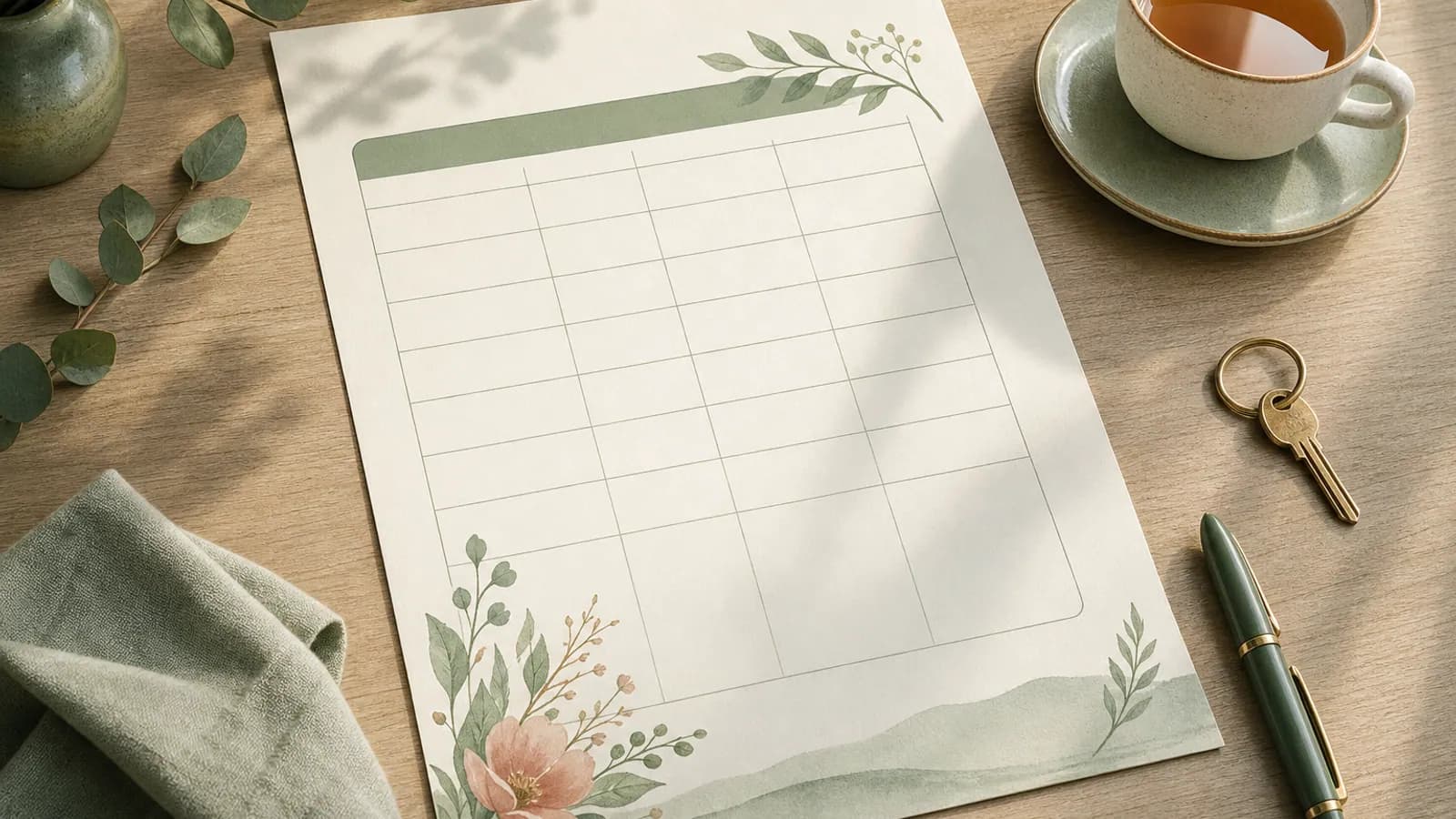
Four sections are enough. Resist adding more until you have used the first version for a few weeks. Each section below has a table you can copy into a shared document or onto paper.
Section 1: the people to call
Start with people, because people are what you need fastest. Include anyone who has a key, a role or a regular visit, and write how they prefer to be reached. If a contact has a back-up, note it.
| Role | Name | How to reach | Best time | Back-up |
|---|---|---|---|---|
| Landlord or building manager | ||||
| Neighbour with a spare key | ||||
| Repairs: plumbing, electrics | ||||
| Internet and phone provider | ||||
| Close friend, first call | ||||
| Family member, first call | ||||
| Workplace contact, each of you | ||||
| Childcare or school contact (later) |
Add a row for anyone whose absence would stop your week: a regular sitter, a cleaner, a pet carer.
Section 2: accounts and services
Here you list what the home subscribes to or depends on: utilities, subscriptions, delivery services, shared apps, the household's calendar. The rule is simple: write the name of the service, whose name the account is under, what it is for and where the login is kept. Never write the password.
| Service | Account holder | What it is for | Renews or is checked | Login is kept in |
|---|---|---|---|---|
| Electricity and water | Home running costs | Monthly | Password manager | |
| Internet | Home connection | Yearly | Password manager | |
| Streaming or other subscription | Entertainment | Monthly | Password manager | |
| Grocery delivery account | Weekly shop | Weekly | Password manager | |
| Shared calendar | All plans and visits | Daily | Both phones | |
| Shared notes or lists | Shopping and to-dos | Weekly | Both phones |
The last column is the most important one. It should say where, not what.
If you can only fill in half of these today, that is the sheet working: the blank cells are the gaps worth closing. For the shared calendar row, agree on a few habits using shared calendar rules for couples.
Section 3: routines that repeat
A household is mostly repetition. Weekly, monthly and yearly routines are where one-person knowledge hides, because the person who does them has stopped noticing that they are tasks. Write them down with a rough timing and the steps in a line or two.
| Routine | How often | Usual day | Quick how-to | Done by |
|---|---|---|---|---|
| Rubbish and recycling out | Weekly | |||
| Grocery order | Weekly | |||
| Laundry | Twice a week | |||
| Pay the regular bills | Monthly | |||
| Check supplies: cleaning, spare bulbs | Every 3 months | |||
| Renew or cancel subscriptions | Yearly |
Section 4: the little facts
Finally, a short list of things people ask for at odd moments: where the spare key is, where the main water valve or the fuse box is, how the heating timer works, the name of the building's door code holder (not the code), where the instruction booklets are. A few lines, in plain words.
The who-knows-what map
This is the part that turns a list into a tool. For every row in the four sections, add two letters: who knows how to do it (K) and who normally handles it (H). Use your initials, or write 'both' or 'nobody yet'. Keep the table short enough to read in a minute; group related rows.
| Item | Knows how (K) | Handles it (H) | Needs a second person? |
|---|---|---|---|
| Pay the internet bill | Alex | Alex | Yes |
| Call the landlord about repairs | Sam | Sam | Yes |
| Reset the router | Both | Sam | No |
| Find the spare key | Both | Both | No |
| Renew yearly subscriptions | Nobody yet | Nobody yet | Yes |
Example with fictional names. The 'needs a second person' column is where you decide what to teach, not who is to blame.
Look at the map for three patterns. Rows where only one person knows how are your single points of failure. Rows where nobody knows are the next tasks to learn. Rows where one person both knows and handles everything are the best place to talk about trading, not as a complaint but as a design question: what would make this easy to share?
Build the first version in one evening
Two people, about ninety minutes, one shared document or one sheet of paper per section. Do not aim for complete; aim for a sheet that exists.
- 1
Choose where it lives
Pick one shared place both of you can open on a phone. A paper copy on the fridge or in the binder is a good back-up. Decide now who may edit it (both of you).
- 2
Fill in separately first, for 15 minutes
Each of you writes down the contacts and services you personally deal with. Doing it apart shows how much each person actually holds.
- 3
Merge the lists
Read both aloud, remove repeats and fill the tables. Mark every blank cell with a question mark rather than guessing.
- 4
Add the who-knows-what columns
Go row by row and say K and H aloud. Write 'nobody yet' without embarrassment. Mark two or three rows as the first to teach.
- 5
Check the no-secrets rule
Read the page once for anything that should not be there: passwords, card numbers, codes. Replace each with where it is kept.
- 6
Set the next review
Put a date three months out in your shared calendar and name who will bring the sheet to it.
Is the sheet ready to share?
Content
- Every contact has a way to reach them and a back-up where possible
- Every account names its holder and where the login is kept
- Every routine has a usual day and a one-line how-to
- No password, card number or door code appears anywhere
Use
- Both of you can open it from your phone
- A printed copy sits in the binder or on the fridge
- Two or three rows are chosen as the first to teach
- The next review is in the calendar
Keep it alive without it becoming a chore
A sheet that is correct once and wrong a year later is worse than none, because people trust it. The fix is a light rhythm, tied to events that already happen.
Whenever something changes
Fix the row on the spot
A new provider, a new neighbour, a changed day for the rubbish: update the line the same day, in one minute.
Every three months
A fifteen-minute review
Read the sheet together over a drink. Update the blank cells, move one 'nobody yet' row to a name, and note one thing to teach.
Once a year
Reread everything
Check contacts still answer, subscriptions still matter and the who-knows-what map still matches real life.
Before any big change
Use it as a checklist
A move, a long trip or a new job all change routines. Walk through the sheet first and adjust it before the change, not after.
If you already hold a regular check-in, add the sheet as a five-minute item. The first steps of planning for a first baby suggest keeping such rhythms small so they survive busy weeks.
Who else should have a copy
The sheet earns its keep the day somebody else needs it. Decide in advance what each reader gets, because not every person needs every section.
| Reader | Sections | Format | Share how |
|---|---|---|---|
| Your partner | All | Shared document and printed copy | Same shared space |
| A friend minding the home | 1, 3, 4 | One printed page | Hand over before you leave |
| A family member as back-up | 1 and the 'who to call' part | Short message or print | Once, then on change |
| A sitter or helper (later) | Routines and little facts | One printed page | Before the first visit |
Leave out the accounts section for anyone who does not need it: it names where logins live, which is private.
Sharing with your partner is the part that matters most. If you want one place where both of you edit the same notes, a shared space helps. In Bloom, Premium adds your partner to the same space, and its AI can help organize your notes and documents; the free plan still gives you a personalized plan, a calendar and notes for your own use.
How long should the sheet be?
One to two pages. If a section needs long instructions, put them in a separate note and link to it. A sheet you can read in ten minutes is the one people will open.
Should I include passwords if the document is private?
No. Write where the login is kept, such as a password manager, and leave the secret out. A document is easy to forward or lose; a pointer is harmless.
What if my partner thinks this is overkill?
Offer a small trial: only the people-to-call table, filled in for fifteen minutes. Most people see its value the first time they have to find a number in a hurry. Describe your own wish ('I want to be able to find this without calling you') rather than a criticism.
I live alone or parent alone. Does it still apply?
Yes, and arguably more. The who-knows-what map becomes a map of who else could step in: a friend, a relative, a neighbour. Fill the 'back-up' column for every contact.
Paper or digital?
Both, ideally: a shared digital copy for editing and a printed copy where a visitor would look. Whichever you pick as the master, say so on the page.
These are suggestions to help you organize, not medical advice. Your professional decides what's relevant for you. How we write and check our articles
Sources
Checked on November 5, 2026. We link to the official pages instead of copying them.
- Greater Good Science Center. How an unfair division of labor hurts your relationship
- Better Health Channel. Relationships and communication