Tools and checklists
A decision log for the big choices of planning a baby
Keep a one-page record of every big choice you make while planning a baby: the options, the reasons, who owns it and when you will look again. Includes a template.
By the Bloom team12 min readUpdated November 6, 2026
Sources checked on November 5, 2026

In this article
You and your partner have talked about where to live, whose job bends and who helps with the baby, and three weeks later you each remember a different version of what was agreed. A decision log fixes that. It is a one-page record of each big choice: what the question was, what you picked, why, who carries it out and when you will look at it again. It takes ten minutes per decision and saves the same argument from happening twice. If you plan alone, it works the same way, with a trusted friend or relative as your second reader.
What counts as a big choice
Not everything belongs in a log. A log full of small items is abandoned in a month, and a log that only holds one giant item is no help. A useful rule of thumb: an item is big if it is expensive or awkward to undo, if it changes how the two of you spend your days, or if other people will plan around it. Where to put the crib is not big. Moving closer to family is.
| Area | Example question | Why it earns an entry |
|---|---|---|
| Home | Stay in this place or move? | Hard to undo, affects money and time |
| Work | Whose schedule changes, and how much? | Changes income and daily routine |
| Money | One shared account, separate ones, or a mix? | Touches trust and every later purchase |
| Care | Who looks after the baby on a normal weekday? | Others will build their lives around the answer |
| Help | Which relatives or friends do we ask for what? | Needs their agreement and clear limits |
| Pace | What is our target month to start the next phase? | Everything else is scheduled backwards from it |
| Big purchases | New car, bigger place, or keep what we have? | Large, and they compete with each other |
| Sharing news | Who do we tell, in what order, and when? | Cannot be taken back once said |
Pick the three or four that are open for you today. Leave the rest for later.
Two of these deserve special care because they quietly shape the rest: work and the weekly split of household tasks. Research summarized by a university research center on relationships finds that couples who share a belief about how to divide the load tend to be happier than couples who hold opposite beliefs, and that how fair the split feels matters as much as the split itself. That is a good reason to write these choices down, so that each of you can see what was agreed rather than guess.
The one-page entry
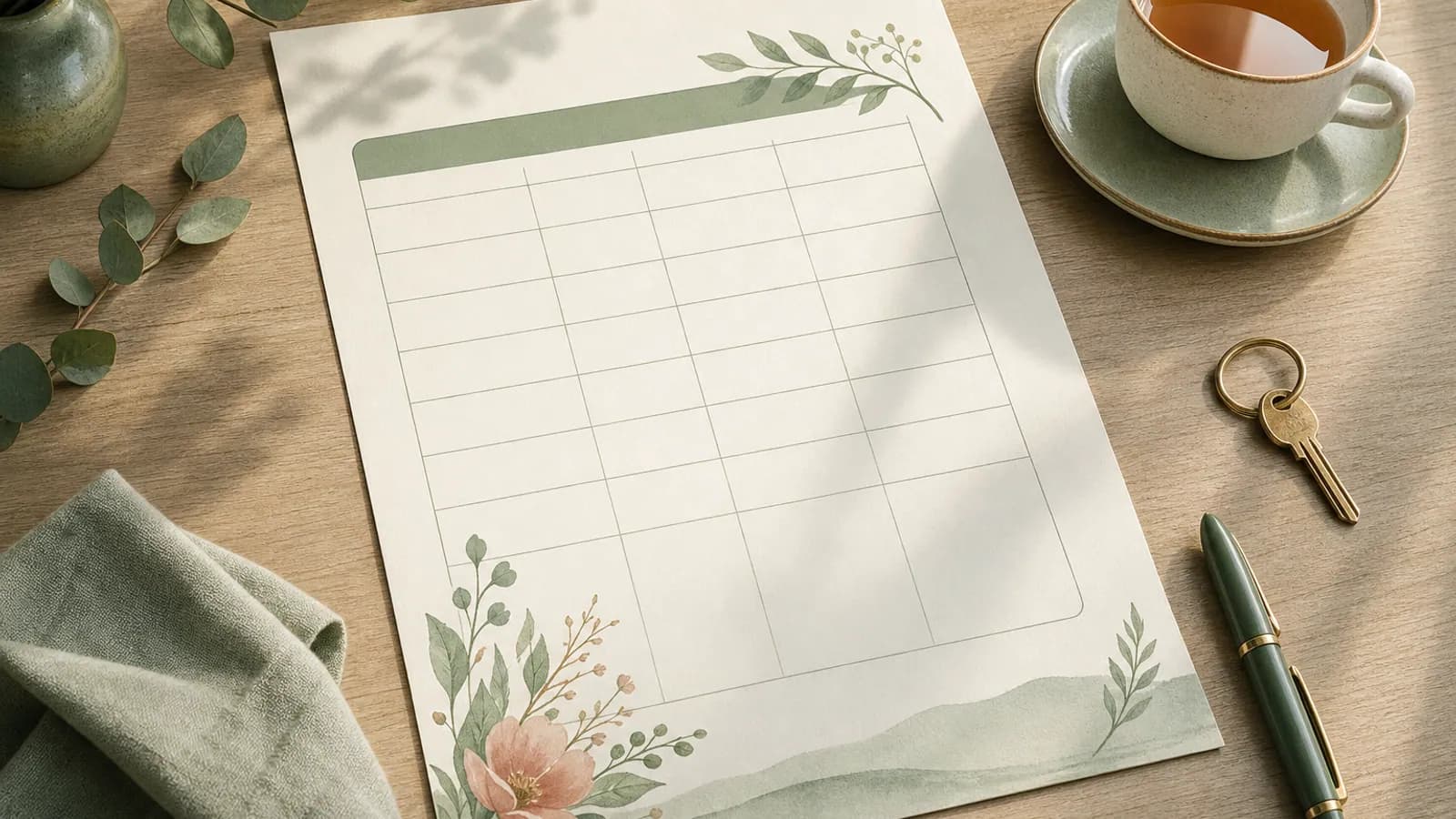
Use the same fields every time. A fixed shape is what makes the log quick to write and quick to read, and it keeps you from skipping the uncomfortable parts. The two columns that people tend to leave blank are the most valuable ones: what each person cares about, and the review date.
| Field | What to write | Example (fictional) |
|---|---|---|
| Question | One sentence, ending in a question mark | Where do we live next year? |
| Options | Two to four real choices, including keeping things as they are | Stay; move to the other side of town; move near family |
| What matters | Two or three points for each person, in their own words | A: short commute. B: help nearby, quiet street |
| Facts we need | What you must find out before deciding, and who finds it | Rent at both places; travel time (B, by the 20th) |
| Decision | The choice, in a sentence anyone could read cold | Stay one more year, then revisit |
| Owner and next step | One name and one action with a date | A: tell the landlord about our plan by the 1st |
| Date decided | The day you agreed, not the day you wrote it | Example: 14 March |
| Review date | When you will look again, and what would reopen it sooner | Review in September; reopen if rent changes |
How to hold the conversation that fills it in
The entry is the output. The value is in the conversation that produces it, and a few habits make that conversation calmer. Relationship education from a public health-wellbeing service suggests setting aside a time to talk without interruption, using 'I' statements to say what you think and need, listening until your partner has finished, and taking a break if you are very angry. Those habits apply here almost word for word.
- 1
Pick one question and a time
Choose a slot of about thirty minutes with phones away, and say in advance which single question you will cover. Surprise decisions in the kitchen at the end of a long day go badly.
- 2
Each person fills in their side first
Before talking, each of you writes your own options and what matters most to you, separately. This stops the louder or faster person from setting the frame.
- 3
Read both sides aloud, without replying
Take turns. The listener only repeats back what they heard: 'So what matters most to you is...'. Replies come after both sides are on the page.
- 4
Find the facts you are missing
Many disagreements are really missing information. List what you need to know, give each item to one person and put a date next to it. Pause the decision until the facts arrive.
- 5
Decide, write it, read it back
Fill the decision, owner and review date together, then read the entry out loud once. If either of you hesitates at any line, fix that line before you close the page.
If you are planning on your own, the same steps work with a trusted person standing in as the second reader. Their job is not to decide for you but to ask 'what would make you change your mind?', which is the question the review date answers.
A worked example, start to finish
Here is how one entry might look after a realistic conversation. Every figure and name is invented, and the choice is only an illustration of the method, not advice about what to pick.
| Field | Entry |
|---|---|
| Question | How do we split the weekly household tasks once the schedule changes? |
| Options | Keep today's split; split by day of the week; split by task type; hire help for one task |
| What matters | A: not being the only one who remembers things. B: predictable evenings and no daily negotiating |
| Facts we need | A lists every recurring task with minutes per week; B checks what outside help would cost (example: 40 currency units a week) |
| Decision | Split by task type. A owns cooking and the calendar; B owns laundry, shopping and bills. Review whether the load feels fair after four weeks |
| Owner and next step | Both: update the shared task list by Sunday |
| Date decided | Example: 2 June |
| Review date | 30 June; reopen sooner if either of us is below 'fine' for two weeks |
Notice that the entry records a feeling check, not only a split. Fairness as it is perceived is part of the data.
The research mentioned above also describes the invisible work of remembering, scheduling and reminding, which tends to land on one partner without anyone choosing it. Naming a calendar owner in the entry, as in the example, turns that invisible job into a visible one that can be shared or swapped. Our guide to shared calendar rules for couples goes into how.
Review dates, and the right way to reopen a decision
A decision is not a vow. Plans change, new facts arrive and a choice that was right in spring can be wrong in autumn. The danger is not changing your mind; it is changing it without saying so, so that one of you works to the old plan and the other to the new. The review date turns reopening into a normal, planned event rather than a sign that someone failed.
Each entry carries one or two reopen triggers: things that would make you look again before the review date. Good triggers are concrete and observable, such as a price rising past a number you wrote down, a change at work, or a relative's plans changing. 'If one of us stops feeling fine about it' is also a valid trigger, and it is the one most couples forget to include.
Monthly ten-minute log review
Before the review
- Open the log and sort entries by review date
- Each person marks any entry that no longer feels right
- Check every 'facts we need' item that was due
During the review
- Read each due entry aloud, decision and reason first
- Ask: has anything on the trigger line happened?
- Confirm, change or postpone, and write which one
- Update the owner and the next step if it moved
After the review
- Add any new big question that appeared as a fresh entry
- Move completed decisions to a 'done' section, never delete them
- Put the next review in the shared calendar
When you disagree and the log stays blank
Some entries will not close. That is information, not failure. The log helps even then, because it shows exactly where you differ: the options, the points that matter to each side and the facts still missing. A blank decision field with a clear list of open items is far better than a vague feeling of being stuck.
Deciding by pressure
- The deadline arrives and the louder preference wins
- Reasons are never written, so the debate returns
- One person quietly carries the cost of the compromise
Feels fast, costs more later
Deciding with the log
- Both sides are on the page before anyone replies
- Missing facts get an owner and a date
- A trial period or a review date turns a standoff into a test
Slower today, steadier afterwards
Three moves help with a stalled entry. First, split it: 'where do we live' often hides 'how long do we stay' and 'how far from family', and those pieces may be easier to settle one by one. Second, agree on a trial: choose the option for a set period, write what you will watch for and review on the date. Third, if you are very upset, stop. Relationship guidance recommends cooling down before you raise a difficult issue, and aiming to understand each other rather than to win.
Where to keep the log so you actually use it
The best format is the one you will open. A shared spreadsheet with one row per decision works well, as does a single shared note with one section per entry. What matters is that both of you can reach it from your phones, that the entry shape stays the same and that it lives next to your other planning material. If you already keep a household information sheet, put the log beside it. If you keep notes from important meetings, as described in taking notes at important meetings, link each note to the decision it feeds.
If you are not sure what the first entry should be, the first question is usually the order of your whole plan. Our article on where to start planning your first baby helps you choose, and the planning folder shows what else belongs near the log.
How many decisions should be in the log at once?
Three or four open entries is plenty. A log with twenty open items turns into a worry list. Close or park old ones before you add more.
What if my partner does not want to write things down?
Offer to be the scribe for the first two entries and to keep it to one page. Many people resist paperwork but accept a shared record once they see that it protects their own preferences from being forgotten.
Can the log help if I am planning on my own?
Yes. Use the same fields and choose one trusted person to read your entries and ask what would change your mind. Writing the options and reasons down already makes your thinking clearer.
How detailed should the reasons be?
One or two sentences. If it takes a paragraph, the entry probably hides two questions. Split it.
What if we change our mind often?
That is a sign the facts or the priorities are not settled yet. Add a 'facts we need' line, and give the decision a longer trial period before you reopen it.
These are suggestions to help you organize, not medical advice. Your professional decides what's relevant for you. How we write and check our articles
Sources
Checked on November 5, 2026. We link to the official pages instead of copying them.
- Greater Good Science Center, UC Berkeley. How an unfair division of labor hurts your relationship
- Better Health Channel. Relationships and communication